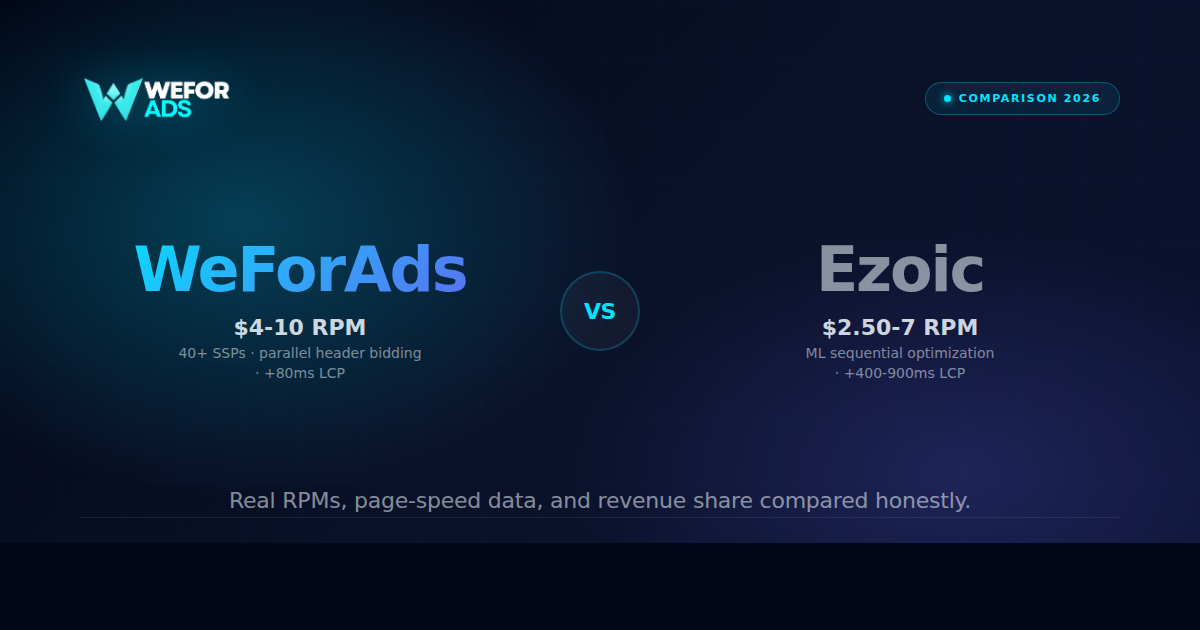
Head-to-head comparison of two popular AdSense alternatives. Real numbers, no inflated claims, and honest notes on where each platform beats the other.
TL;DR: For publishers above 100,000 monthly pageviews, WeForAds pays 30-60% more than Ezoic on the same inventory because it uses real header bidding with 40+ demand partners instead of Ezoic's slower one-at-a-time machine-learning optimization. WeForAds also loads significantly lighter (saves 400-900ms in LCP on most sites). Below 100K PVs, Ezoic wins by default because WeForAds has a traffic minimum. Both are legitimate Google-approved platforms — the question is which fits your stage.
The fundamental architectural difference
Before comparing features, you need to understand how each platform actually earns revenue, because that dictates everything else.
Ezoic uses what they call "machine learning ad optimization." In practice, this means Ezoic tests different ad configurations against each page view — one layout for user A, a different one for user B — and over weeks learns which configurations generate the highest RPM. It's a useful idea for publishers with no ad ops experience because it's set-and-forget. But it's sequential by design: one configuration competes at a time, and learning takes weeks per change.
WeForAds uses header bidding — specifically Prebid.js orchestrating 40+ demand partners (SSPs and ad exchanges) on top of Google Ad Manager. On every single ad request, all 40+ partners bid simultaneously in a parallel auction, and whichever one bids highest wins that impression. No A/B testing cycle is needed because the optimization happens in real-time, per impression, every time.
That architectural difference is the reason every head-to-head metric below goes the way it does.
Side-by-side comparison
| Metric | WeForAds | Ezoic |
|---|---|---|
| Traffic minimum | 100,000 monthly PVs | None (Access Now tier) |
| Typical RPM | $4-10 | $2.50-7 |
| Auction type | Parallel header bidding (40+ SSPs) | Sequential ML optimization |
| Demand partners | 40+ (Rubicon, OpenX, PubMatic, Criteo, IX, MGID, Amazon, more) | Ezoic's internal stack (smaller) |
| Page speed impact | +80-150ms LCP | +400-900ms LCP |
| Core Web Vitals hit | Minimal | 15-30 point drop |
| Revenue share | Transparent (shown per report) | Opaque (~10% implicit) |
| Approval time | 1-3 business days | 24-48 hours |
| Ad formats | 19 (display, anchor, sticky, in-image, outstream video, scroll, exit-intent, more) | Standard display + Humix video + sidebar |
| Exclusive contract | No — run alongside AdSense/direct deals | No |
| ads.txt management | Auto-generated, always current | Auto-managed via NameSpace (DNS required) |
| Dashboard reporting | Per-bidder, per-placement, real-time | Complex, aggregated, delayed |
| Non-US traffic RPM | Strong (MGID, Bidmatic, Vidazoo specialize) | Weak outside US/UK/CA |
| Account support | Dedicated onboarding manager | Self-serve + ticket |
RPM comparison: what publishers actually earn
Ezoic's own typical RPM is $2.50-$7 for English-language content with decent US traffic. WeForAds typically lands at $4-$10 on comparable inventory. The gap comes from three places:
- More bidders competing per impression. 40+ SSPs bidding in parallel beats any single-network optimization layer in a majority of auctions, simply because there's more competition.
- Specialized non-US demand. SSPs like MGID (Eastern Europe), Bidmatic (LATAM), and Vidazoo (Asia, Middle East) pay 3-5x what Ezoic's blended stack does for the same non-US impression.
- Lower implicit revenue share. Ezoic takes approximately 10% before you see revenue. WeForAds' share is transparent and shown in your dashboard per report, so you know exactly what's getting kept at each step.
The 30-60% lift number above isn't guaranteed — individual results vary based on niche, geography, and ad density — but it's what we consistently see when publishers migrate from Ezoic and send us before-and-after RPM screenshots from their dashboards.
Page speed: the silent revenue killer
Here's the Ezoic tradeoff nobody mentions: Ezoic's optimization layer (Leap, Humix, Site Speed Accelerator) adds substantial client-side overhead. On a typical WordPress blog:
- Largest Contentful Paint (LCP) climbs 400-900ms after installing Ezoic.
- Total Blocking Time (TBT) increases 200-500ms from the extra scripts.
- Lighthouse Performance score drops 15-30 points.
This matters because Google uses Core Web Vitals as a ranking signal. Slower pages rank lower, get less organic traffic, and earn less ad revenue — even if the per-impression RPM is fine. We've seen publishers lose net revenue after installing Ezoic because the CWV drop cut their organic traffic by 20%+.
WeForAds typically adds 80-150ms to LCP because the tag architecture is server-side-decisioned — one tag per site, no runtime A/B testing, no heavy optimization wrapper. Prebid.js is loaded once and shared across all units.
Traffic minimums: where Ezoic wins
Credit where it's due. Ezoic's biggest strategic advantage is zero traffic minimum. A brand-new blog with 500 monthly visitors can sign up and start earning. WeForAds requires 100,000 monthly pageviews because below that threshold, header bidding overhead (SSP auctions, ads.txt management, onboarding time) earns less than it costs to provision.
If you're under 100K PVs, Ezoic is your answer — full stop. Use it until you cross 100K, then migrate.
Ad format breadth
Ezoic's format catalog is relatively narrow: standard display units, a sidebar sticky, and Humix (their embedded video player). That's sufficient for a typical blog.
WeForAds ships with 19 ad formats out of the box:
- Standard display (in-content, above-fold, below-fold)
- Sticky footer, sticky top, sticky sidebar
- Anchor ads (bottom-pinned with close button)
- Side rails (desktop sidebar ads)
- In-image overlay (monetizes article images)
- Outstream video (sticky bottom-right player)
- Scroll ads (triggered as user scrolls)
- Exit-intent ads
- Notification-style ads (top + bottom)
- Revenue rescue (fills AdBlock traffic legitimately)
- Smart density (auto-adjusts ad count per session)
- Sticky session (pinned ads during engaged sessions)
Each format is policy-compliant, user-controllable (every sticky and floating unit has a close button), and independently configurable per site.
Where Ezoic genuinely beats WeForAds
We're not going to pretend Ezoic is bad. There are real situations where it's the better choice:
- You're under 100K monthly pageviews. No contest — WeForAds isn't accepting you.
- You want zero ad ops involvement. Ezoic's ML optimization is set-and-forget. WeForAds has a richer dashboard but expects you to configure placements yourself (or work with our onboarding team).
- You want Ezoic's site-speed tools and caching. Ezoic's Leap + CDN combo is a full performance stack. WeForAds focuses purely on monetization — you'd bring your own CDN/caching.
- You want integrated video hosting. Humix is a bundled video player + hosting platform. WeForAds offers outstream video ads but doesn't host your content video.
For most publishers though, those edge cases don't outweigh the RPM and page-speed differences.
Migrating from Ezoic to WeForAds: what actually happens
If you're ready to switch, the migration takes about 2-3 hours of active work spread over a week:
- Day 0: Apply to WeForAds. Site review usually completes within 1-3 business days.
- Day 2-3: Approved + onboarding call. Your onboarding manager maps your current Ezoic placements to WeForAds equivalents. You'll get the WeForAds tag.
- Day 4: Swap DNS (if using Ezoic NameSpace). Point your domain's nameservers back to your hosting provider. If you used Cloudflare DNS or your host's DNS, skip this step.
- Day 4: Remove Ezoic JavaScript. Delete the Ezoic plugin or `<script>` tags. Install the WeForAds tag (single `<script>` in `<head>`).
- Day 5: ads.txt update. WeForAds auto-generates your ads.txt. If you run an ads.txt manager plugin, point it at our dynamic endpoint.
- Day 6-14: Demand partners learn your inventory. RPMs climb daily as SSPs accumulate data about your traffic. Stable RPMs typically show by day 14-21.
Revenue dip during migration is usually 2-4 days of ~30% lower earnings while the new demand partners crawl your site and begin bidding. Total revenue recovers and surpasses baseline within 2-3 weeks for most publishers.
The verdict
If you're under 100K monthly pageviews: Ezoic is the right answer. Use it until you cross 100K.
If you're between 100K and 500K monthly pageviews: WeForAds. This is exactly the band where header bidding starts paying serious dividends, and Ezoic's ML optimization is capped.
If you're above 500K monthly pageviews: WeForAds with direct PMP deals layered in. At this size, the RPM gap between header bidding and ML optimization widens significantly, and you have enough inventory for premium direct sales.
If you have significant non-US traffic (>40%): WeForAds at any size above 100K. Ezoic's demand stack underpays non-US inventory. WeForAds' specialized regional SSPs (MGID, Bidmatic, Vidazoo) pay 3-5x more per non-US impression.
Ready to see what your site could earn?
Apply to WeForAds (1-3 business day review). If you're already on Ezoic, your onboarding manager will handle the migration step-by-step.
Apply to WeForAds →Frequently Asked Questions
Does WeForAds pay more than Ezoic?
For publishers with 100,000+ monthly pageviews, WeForAds typically pays 30-60% more per thousand pageviews than Ezoic. The reason is auction mechanics: WeForAds runs real parallel header bidding with 40+ demand partners competing simultaneously, while Ezoic uses a slower machine-learning optimization that tests one configuration at a time. For publishers under 100K PVs, Ezoic is the more accessible choice because WeForAds has a traffic minimum.
Is Ezoic or WeForAds better for page speed?
WeForAds is significantly lighter on page speed. Ezoic's Humix player and multiple optimization scripts typically add 400-900ms to Largest Contentful Paint (LCP) and pull Core Web Vitals scores down by 15-30 points. WeForAds injects only the Prebid.js bundle (shared with Google Ad Manager) and format-specific runtime JavaScript, adding roughly 80-150ms to LCP on most sites.
Do I have to choose between WeForAds and Ezoic?
Technically yes — running both simultaneously creates overlapping ad auctions and policy conflicts with Google. Most publishers pick one. If you're above 100K PVs and want maximum revenue, WeForAds is the stronger choice. Below that threshold, Ezoic is the most accessible starting point because it has no traffic minimum.
How long does it take to switch from Ezoic to WeForAds?
Onboarding takes 1-3 business days once you apply. The migration itself involves removing Ezoic's JavaScript from your site, pointing your domain's nameservers back to your hosting (if you used Ezoic's NameSpace), and installing the WeForAds tag. Most publishers see their revenue stabilize within 7 days and start seeing the RPM lift within 14-21 days as demand partners learn the new inventory.
Does Ezoic have a traffic minimum?
Ezoic removed its 10,000 monthly visit minimum in 2021 and now accepts publishers of any traffic size into its Access Now tier. Higher tiers (Levels 1-4, Premium, VIP) unlock at 50,000, 100,000, and 500,000+ monthly visits respectively.
Why is WeForAds faster than Ezoic for page speed?
Ezoic inserts a heavy client-side optimization layer (Leap, Humix, Site Speed Accelerator) on top of ad loading, which adds multiple scripts, DNS lookups, and runtime tests on every page view. WeForAds uses server-side decisioning to build a single tag per site, avoiding runtime optimization overhead and keeping the critical rendering path lean.
Related reading
- WeForAds vs Mediavine: Which Pays More & Approves Faster?
- Best AdSense Alternatives 2026: 11 Ranked by Real RPM
- Best Ad Networks for Publishers (10-network comparison)
- AdSense vs Header Bidding: Which Earns More?
- Header Bidding vs Waterfall: Why Publishers Are Switching
- Free ads.txt Validator Tool
- Free Ad Revenue Calculator